Canada Time Zone Map
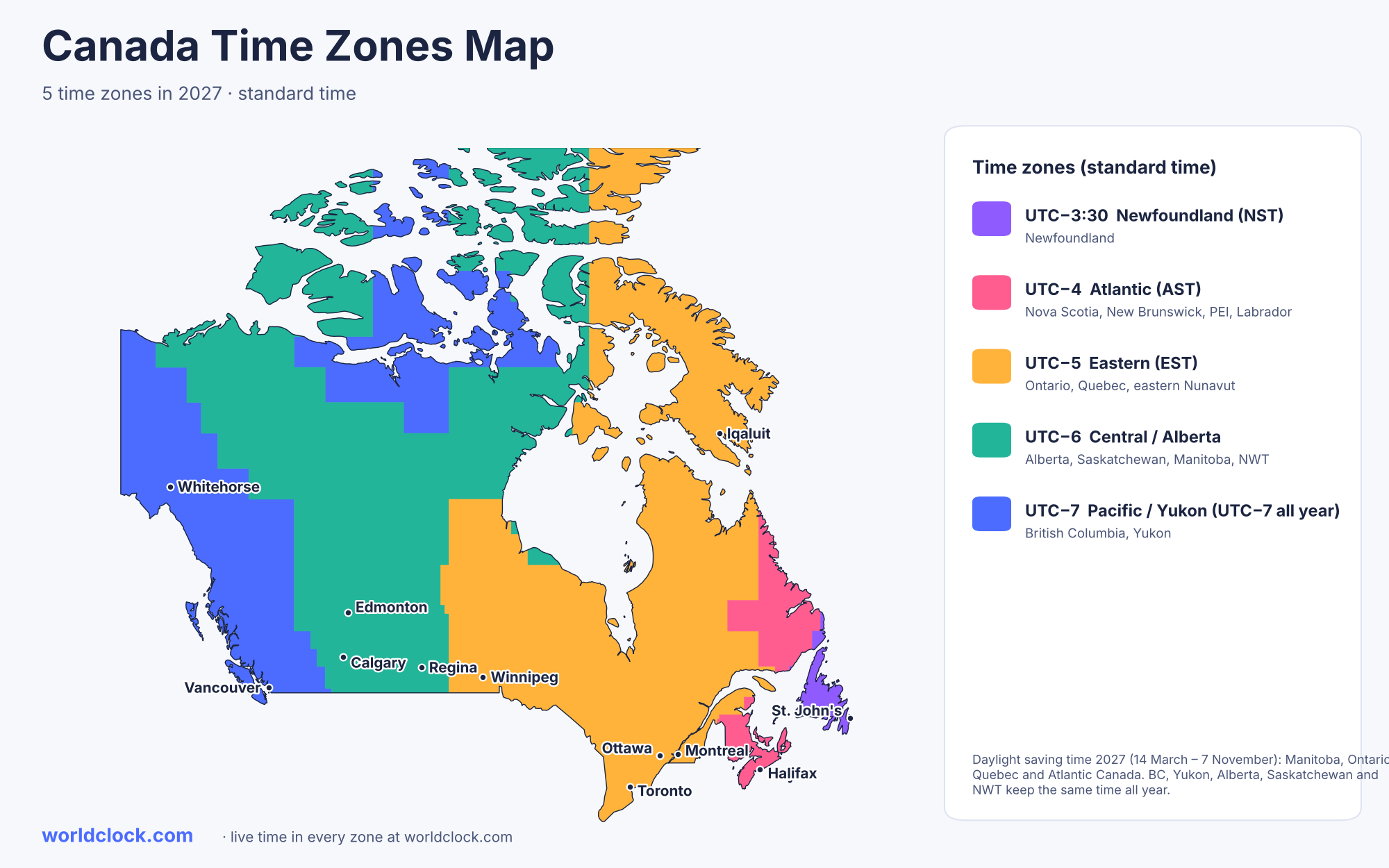
Canada stretches across six standard time zones, from Pacific to Newfoundland. In 2026 several provinces stopped changing their clocks, so the map of local times looks different from before.
Current time in every Canada time zone
British Columbia (most of the province)
Yukon
Alberta, Northwest Territories, eastern British Columbia (Cranbrook, Golden), Lloydminster (Saskatchewan)
Western Nunavut (Kitikmeot Region)
Saskatchewan (most of the province)
Manitoba, northwestern Ontario (Kenora and Rainy River districts)
Central Nunavut (Kivalliq Region)
Atikokan area (Ontario), Southampton Island (Nunavut)
Ontario (most), Quebec (most), eastern Nunavut (Iqaluit)
Nova Scotia, New Brunswick, Prince Edward Island, most of Labrador
Newfoundland and southeastern Labrador
Canada time zones: questions and answers
How many time zones does Canada have?
Canada has six standard time zones: Pacific, Mountain, Central, Eastern, Atlantic and Newfoundland. Because some provinces now keep the same time all year, the number of different local times in use changes with the seasons.
Which provinces do not change their clocks?
Saskatchewan (since the 1960s) and Yukon (since 2020) stay on one time all year, and in 2026 British Columbia, Alberta, Manitoba and the Northwest Territories also stopped changing their clocks. Most of Ontario and Quebec, Atlantic Canada, Newfoundland and Nunavut still change twice a year.
Why is Newfoundland half an hour different?
Newfoundland Time is UTC−3:30 (UTC−2:30 in summer), set to match the island's position east of the Atlantic zone. It is one of the few half-hour time zones in the Americas.