US Time Zone Map
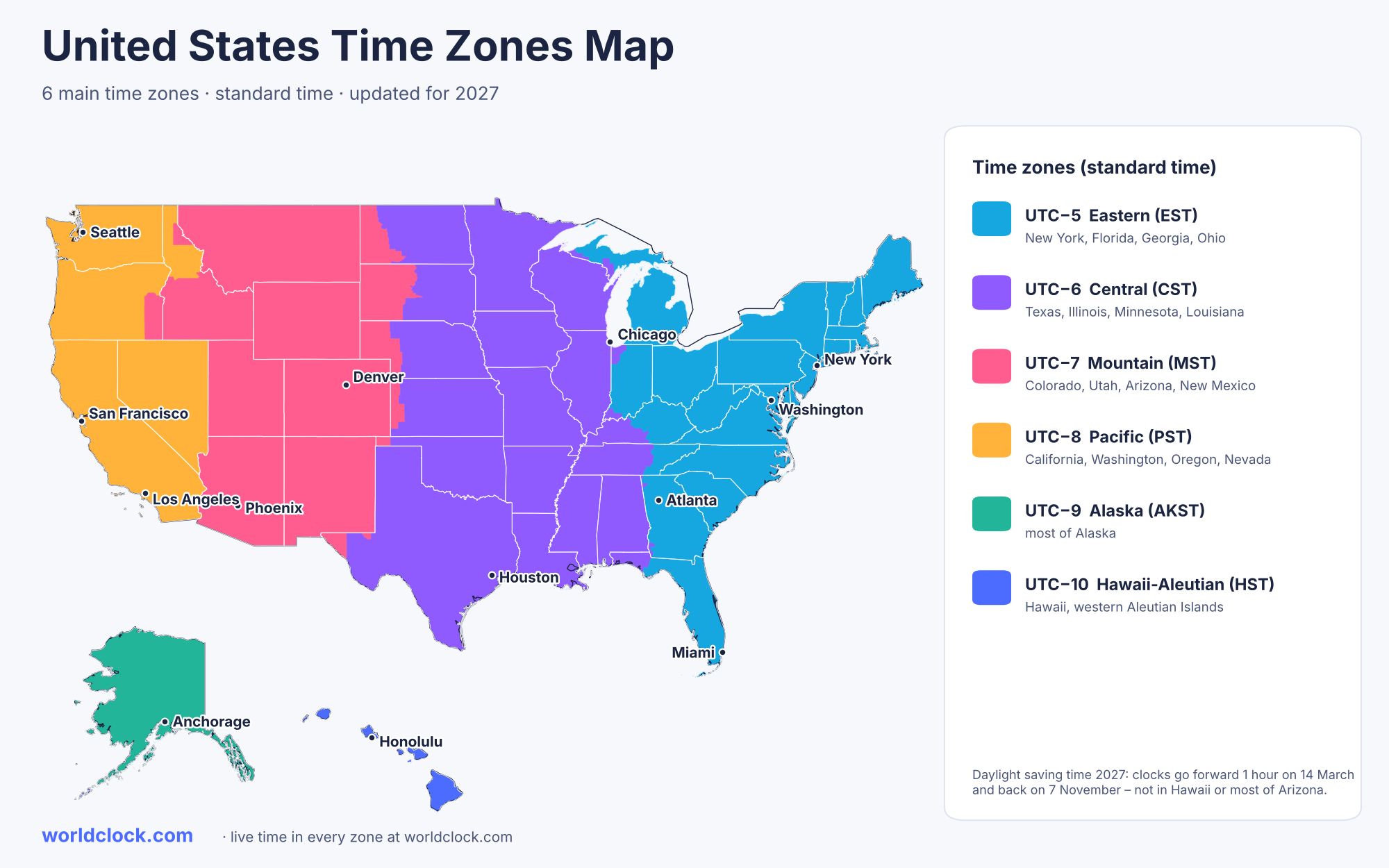
The 50 states and Washington, D.C. use six time zones – nine including the territories. Here is the live time in each zone and which states belong to it.
Current time in every US time zone
Connecticut, Delaware, District of Columbia, Georgia, Maine, Maryland, Massachusetts, New Hampshire, New Jersey, New York, North Carolina, Ohio, Pennsylvania, Rhode Island, South Carolina, Vermont, Virginia, West Virginia; most of Florida, Indiana, Kentucky (east), Michigan and Tennessee (east)
Alabama, Arkansas, Illinois, Iowa, Louisiana, Minnesota, Mississippi, Missouri, Oklahoma, Wisconsin; most of Kansas, Nebraska (east), North Dakota, South Dakota (east), Tennessee (middle and west) and Texas; western Kentucky, the Florida Panhandle west of the Apalachicola River, NW and SW corners of Indiana, four Michigan counties bordering Wisconsin
Colorado, Montana, New Mexico, Utah, Wyoming; southern Idaho, western Kansas (4 counties), western Nebraska, SW North Dakota, western South Dakota, most of Malheur County (Oregon), El Paso and Hudspeth counties (Texas), the Navajo Nation in Arizona
Arizona (except the Navajo Nation) – no daylight saving time
California, Nevada, Washington; most of Oregon; northern Idaho (the Panhandle)
Alaska (all but the western Aleutian Islands)
Hawaii – no daylight saving time
Aleutian Islands west of 169.5° W (Alaska)
Puerto Rico, US Virgin Islands
Guam, Northern Mariana Islands
American Samoa
US time zones: questions and answers
How many time zones does the United States have?
The 50 states and Washington, D.C. use six time zones: Eastern, Central, Mountain, Pacific, Alaska and Hawaii–Aleutian. Including Puerto Rico and the US Virgin Islands (Atlantic), Guam and the Northern Mariana Islands (Chamorro) and American Samoa (Samoa), there are nine.
Which US states have two time zones?
Thirteen states are split between two time zones: Alaska, Florida, Idaho, Indiana, Kansas, Kentucky, Michigan, Nebraska, North Dakota, Oregon, South Dakota, Tennessee and Texas.
Does the whole US use daylight saving time?
No. Most of the country moves its clocks forward on the second Sunday in March and back on the first Sunday in November, but Hawaii, most of Arizona and the territories stay on standard time all year. The Navajo Nation in Arizona does use daylight saving time.